
Service design
We help organisations make their services simpler, faster and more impactful by focussing their teams on users’ needs.
Read more
LNER (London North Eastern Railway)
UK
Department for Transport
2026
LNER (London North Eastern Railway) is a British rail operating company owned by the Department for Transport.
With a revenue of over £1 billion, it provides long-distance inter-city services on the East Coast Main Line to and from London, calling at 54 stations along its network and managing 11 stations directly.
25 million passenger journeys are made annually on LNER’s service, which covers a network of nearly 1000 miles. LNER employs over 3,000 members of staff.

LNER operates a highly time-critical and safety-critical service. The long distances covered by its network mean that variations from normal service, be it a broken seat or a delayed train, has complex and high-impact outcomes for staff and customers. Reducing and mitigating the disruption from breaks in the logistics chain is one of LNER’s core challenges as an organisation.
LNER has already made significant progress in becoming a digitally advanced rail company, having developed its ways of working in service design, user-centricity, and data management.
At the same time, the organisation wanted to harness AI and apply it to the challenge of managing its complex logistics chain - building the technology and design capabilities to be able to test new solutions quickly and improve the service for both staff and customers.
We helped LNER understand the needs and friction points of its staff through intensive user research
We used AI to help them develop several concepts to address some of the challenges surfaced during user research, going from an idea to a testable prototype in just 2 weeks
We enabled LNER to harness collective staff knowledge and take ownership of AI prototyping internally
We helped LNER examine cultural barriers to help them embed AI and user-centered research as they build out their product pipelines

We conducted thorough user research to understand the challenges faced by frontline staff
We shadowed and interviewed LNER frontline staff - including observing them on trains and in both terminus and non-terminus stations.
This enabled us to build a comprehensive picture of the staff experience, the potential points of friction for staff delivering the service, and the way they work with colleagues to address complexity or disruption.
We also visited the operations centre to observe how LNER works with its partners such as Hitachi and Network Rail, how disruption is handled, and how train defects are triaged and managed.
Working alongside LNER, we explored the friction points we had observed in the staff working day, including:
We worked with LNER to develop several AI prototypes to address the challenges experienced by staff
We worked with the team to rapidly develop a variety of prototypes using AI tools including Claude, Gemini AI Studio, and Replit, going from an idea to a working prototype in only 2 weeks.
The prototypes we developed included:
A part of PD’s foundational test and learn approach, the process of developing prototypes at pace allowed LNER to test with users to receive feedback and identify value, serving as a rapid and low-cost way to learn. By signifying intent to address and resolve the challenges of frontline staff, it also helped to build trust between frontline teams and LNER head office.
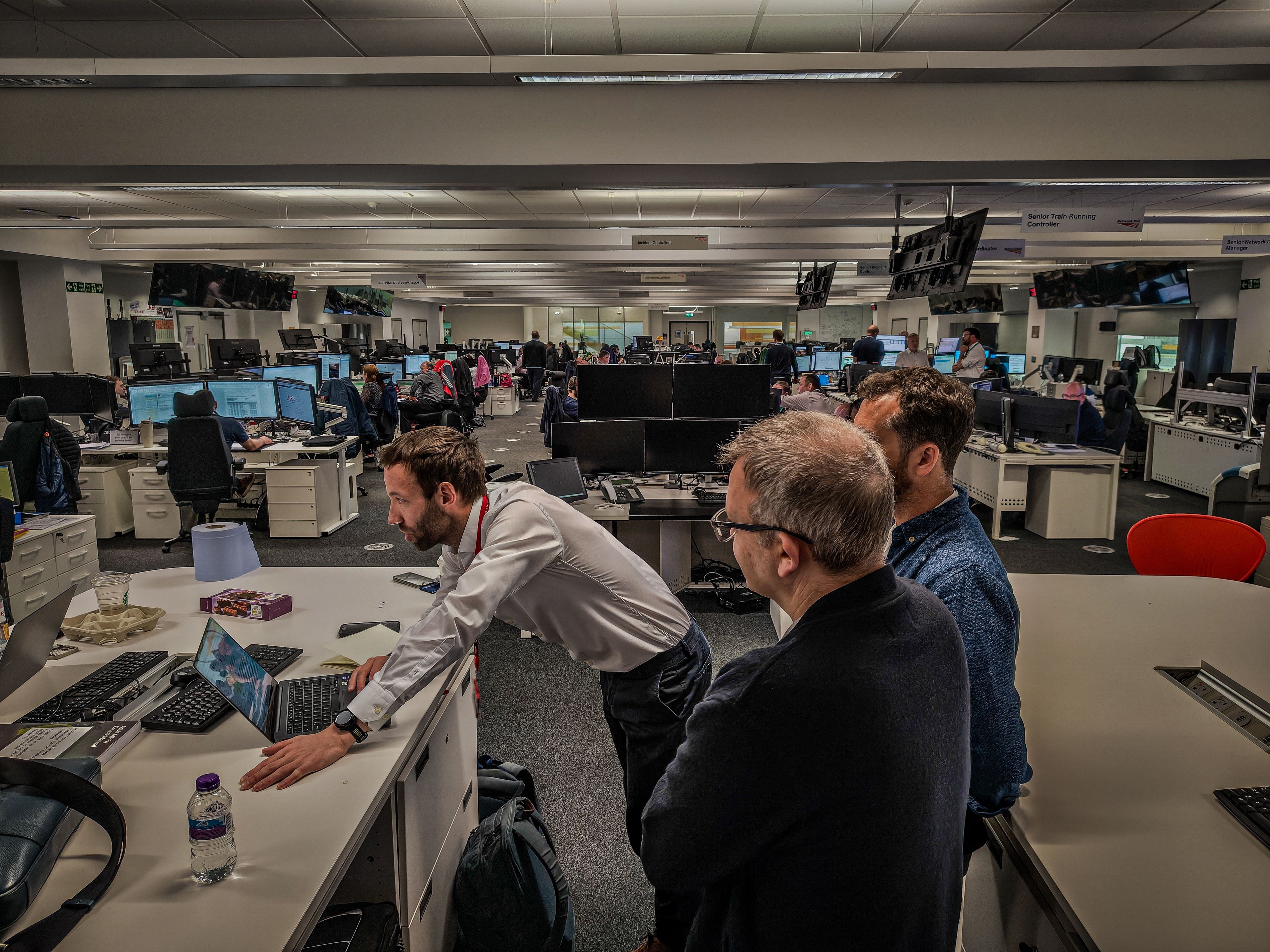
We empowered LNER to use new technologies to solve problems at pace, and confront cultural and operational barriers
While staff flagged the potential utility of several of our prototypes, the main outcome was a demonstration of LNER’s capability to rapidly test new technologies to solve problems.
Our prototypes were developed using internal AI tools which freed the client from reliance on an external dev agency. This enabled them to take control of their own work - building an understanding of staff user needs, and harnessing the deep collective knowledge of staff.
Critically, the process of user research and rapid prototyping also surfaced operational and cultural barriers. For example, prototyping the shared decisions log compelled LNER to confront the way decisions are made among its frontline teams, and begin to work through those cultural challenges.
LNER are now well-positioned to use their newly developed AI prototyping capabilities, understanding of staff needs, and new ways of working to help them solve some of their biggest organisational challenges during a period of significant change.
