
Government
We work with countries, states and government departments to help them achieve transformation at scale.
Read more
The infected blood scandal is one of the most high-profile public health crises in UK history, with thousands of individuals infected with Hepatitis B & C, and HIV, through contaminated blood products from the 1950s to the 1990s. After years of campaigning and a decades-long wait for justice, the Infected Blood Compensation Authority (IBCA) was established to provide long-overdue financial redress to victims and their families, marking a major step in addressing the injustices.
Public Digital was commissioned by the Cabinet Office in May 2024 to support the creation of IBCA and design the new compensation service. This would provide compensation to the thousands of infected people, and many thousands of family members and carers also affected.
In summer 2024, IBCA was beginning to form as an entirely new organisation with no developed infrastructure. They faced the challenge of resolving thousands of claims, many of them complex, in an environment with a high degree of public scrutiny, changing regulation, and the pressure of a public government commitment to begin payments of compensation before the end of 2024.

We helped the government establish a brand new institution, embedding a test and learn and user-centred culture to deliver with empathy.
With our support, IBCA’s service was operational and making its first payments after only 111 days from legislation passing.
We helped the organisation scale from a team of 12 in June 2024 to a team of over 500 in 2026, with over £2bn paid out in compensation.
We helped build lasting capabilities for the organisation, including a sustainable operational policy function.
We helped the government establish a brand new Arms Length Body, embedding a test and learn and user-centred culture to deliver with empathy, at pace.
The Victims and Prisoners Bill was passed in late May 2024. From a standing start we supported the IBCA Chair and Interim CEO to shape its early organisation, helping define a culture and operating model that emerged from practice. We supported the CEO’s ambition to create a test and learn culture at the heart of the organisation by defining its vision and purpose, and by creating design principles that codified this way of working. Throughout our time with IBCA we worked with the CEO, Exco and Board to develop governance models and processes to enable better decision-making in support of this way of working, and helping to enshrine it in an operating model.
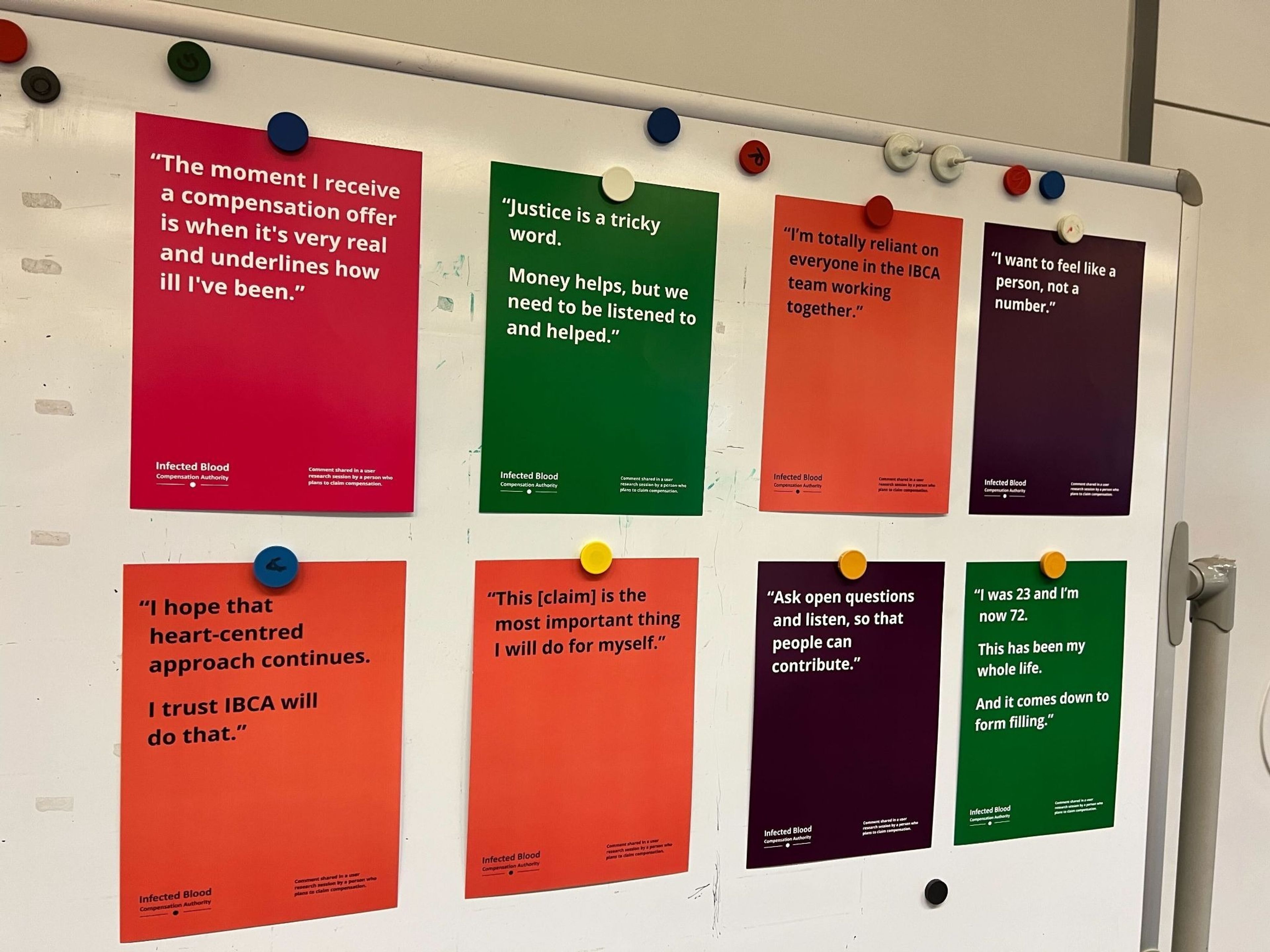
We took a user-centred approach to developing the service, involving rigorous user research working concurrently with claim managers and people who expected to make claims, and shaping the service around the needs we surfaced. We developed a model where those making claims built 1:1 relationships with their claim managers, allowing them to share their stories and feel heard. We helped develop rapid feedback loops so the service could iterate quickly, and established a user-centred culture by creating posters illustrating user quotes and feedback, reminding everyone in IBCA of the importance of the community's needs.
With our support, IBCA’s service was operational and making its first payments after only 111 days from legislation passing.
In the face of numerous pressures and the need to get the service right the first time, rather than aiming for ‘all at once’ delivery that would have taken much longer to start, we supported IBCA to begin with a small number of claims before learning and iterating the approach.
Our focus on iterative delivery ensured IBCA were scaling a service and a way of working which was proven to be effective. This was particularly important given the high degree of public scrutiny, and the need to ensure the experience of the service was in line with the needs of those making claims.
This also enabled the organisation to deliver more rapidly than expected. IBCA was able to process its first claims, and deliver compensation to the first claimants, within months of being established.

We helped the organisation scale from a team of 12 in June 2024 to a team of over 500 in 2026, with over £2bn paid out in compensation in the first 15 months.
Following its first payments, IBCA was facing understandable pressure to accelerate its efforts to ensure all eligible infected people were paid as soon as possible. We supported IBCA by developing key materials to enable this scaling, including operational guidance, inputting into training materials, creating content such as letters and call guides, helping develop a model office approach, and constantly iterating the service design.
We also helped design new user journeys to support compensation claims from other groups such as the carers, husbands, wives and children of living or deceased infected people and supported IBCA to launch these by the end of 2025.

We helped build lasting capabilities for the organisation
While the Infected Blood Compensation Regulations set out the legislative framework for the compensation scheme, it became clear early on that the Infected Blood Compensation Authority would need its own operational policy function. Our team helped to create and run this function, resolving critical questions while working at the intersection of user-centred design, operations and policy. This approach built trust and credibility with stakeholders across various departments.
By identifying undesirable ambiguity in the legislation and obtaining policy clarifications, we established a test-and-learn cycle with the legislative team, helping to ensure tighter definitions were written into regulations. These changes addressed the regular challenges we encountered during practical application. We also helped the organisation recruit for its policy unit and define its operating model and processes, before handing the function fully over to IBCA to operate itself. This ensured a lasting capability for the organisation.

