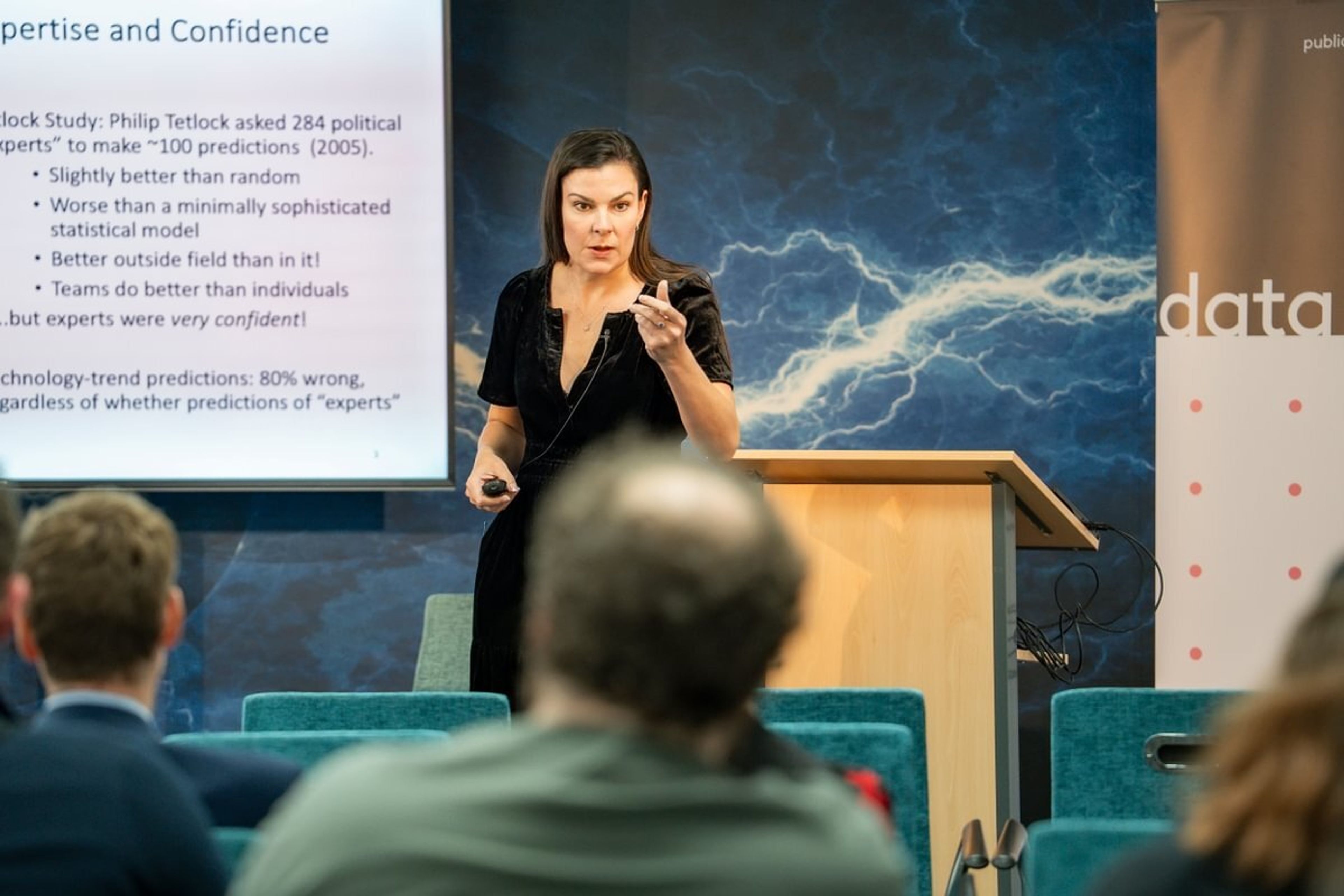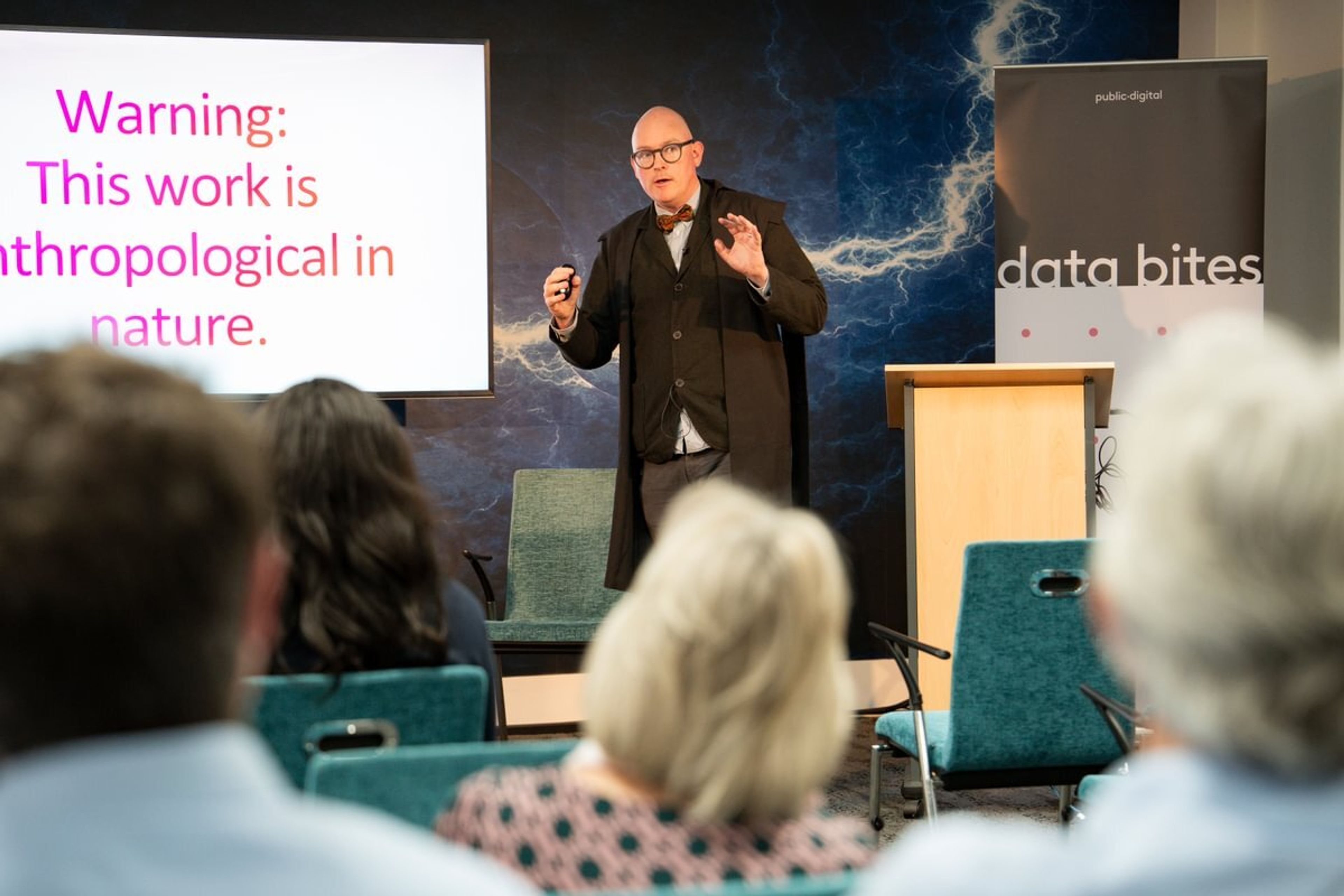
You can’t API your way out of politics
Alex Blandford shows his qualitative research into civic technologists, painting them as “radicalised nerds” trying to fix broken systems.
Read more
Our final Data Bites of 2025, the 60th overall, had a focus on statistics and how to discover data. We heard about data portals in Wales and Scotland, the new Statistics Code of Practice, and a consultation on the 2031 Census, with our speakers encouraging people to take a look, try them out and give feedback.
If you’ve not been (or seen) before: Data Bites is a monthly event showcasing how data is used in and around the public sector. Four speakers get eight minutes to present – there are eight bits in a byte, hence eight minutes in a Data Bite – followed by eight minutes of audience questions. November’s event was the eleventh Data Bites hosted by Public Digital, after 49 events at the Institute for Government.
Watch the recording of the event below, and access summary and links to some of the presentations.
Stephanie Howarth, Chief Statistician, Welsh Government, joined us from Cardiff to talk about the relaunch of StatsWales (Welsh version here). The new portal is currently in beta, and you can sign up to help with user research (or email StatsWales@gov.wales with feedback).
There’s more information in Steph’s slides, and in her answers to our standard set of questions:
Can you summarise your project in a few sentences?
StatsWales is the Welsh Government’s official platform for accessing open data and statistics about Wales. We’re moving StatsWales from an outdated, hard-to-use system to a modern, accessible and user-focused service. Our aim is to make Welsh statistical data easier to find and use – supporting everyone from policymakers to the public with high-quality, open data.
What problem are you trying to solve?
The old StatsWales platform was clunky, hard to navigate, and built on outdated technology. Users struggled to find and interrogate data, share information, and were frustrated with data inconsistencies. It also failed to meet modern accessibility standards. Those publishing data found it challenging and faced inefficient, error-prone workflows. Our project addresses these pain points by rebuilding the service from the ground up, focusing on user needs, data quality, and robust digital standards.
What difference will it make to citizens?
Citizens will benefit from a more accessible, reliable, and user-friendly service for Welsh data. Whether you’re a local authority, charity, journalist, or member of the public, you’ll be able to find and access official data more easily. Improvements in data standards will result in better quality data which is easier to use.
How will you know when it’s succeeded?
We’ll be measuring success through user feedback and the ability of a diverse range of users to find and use the data they need. We’ll look for improvements in accessibility, data quality, and user satisfaction, as well as a reduction in workflow issues for the teams that prepare and publish data. Ultimately, success means the platform is trusted, widely used, and meets the needs of all its users.
What are the main hurdles?
Key challenges so far have included
recruiting a diverse range of users for research and testing
addressing the wide spectrum of data expertise among users, who want to find and access data in different ways
managing the inevitable disruption that comes with change. Not everyone will like the new service immediately, and meeting the needs of both lay and expert users is an ongoing process.
If you could change one thing about data in government, what would it be?
I’d champion greater standardisation and quality in government data. Adopting common data standards and providing robust metadata will make data easier to use, more trustworthy, and more accessible – benefiting everyone from analysts to citizens.
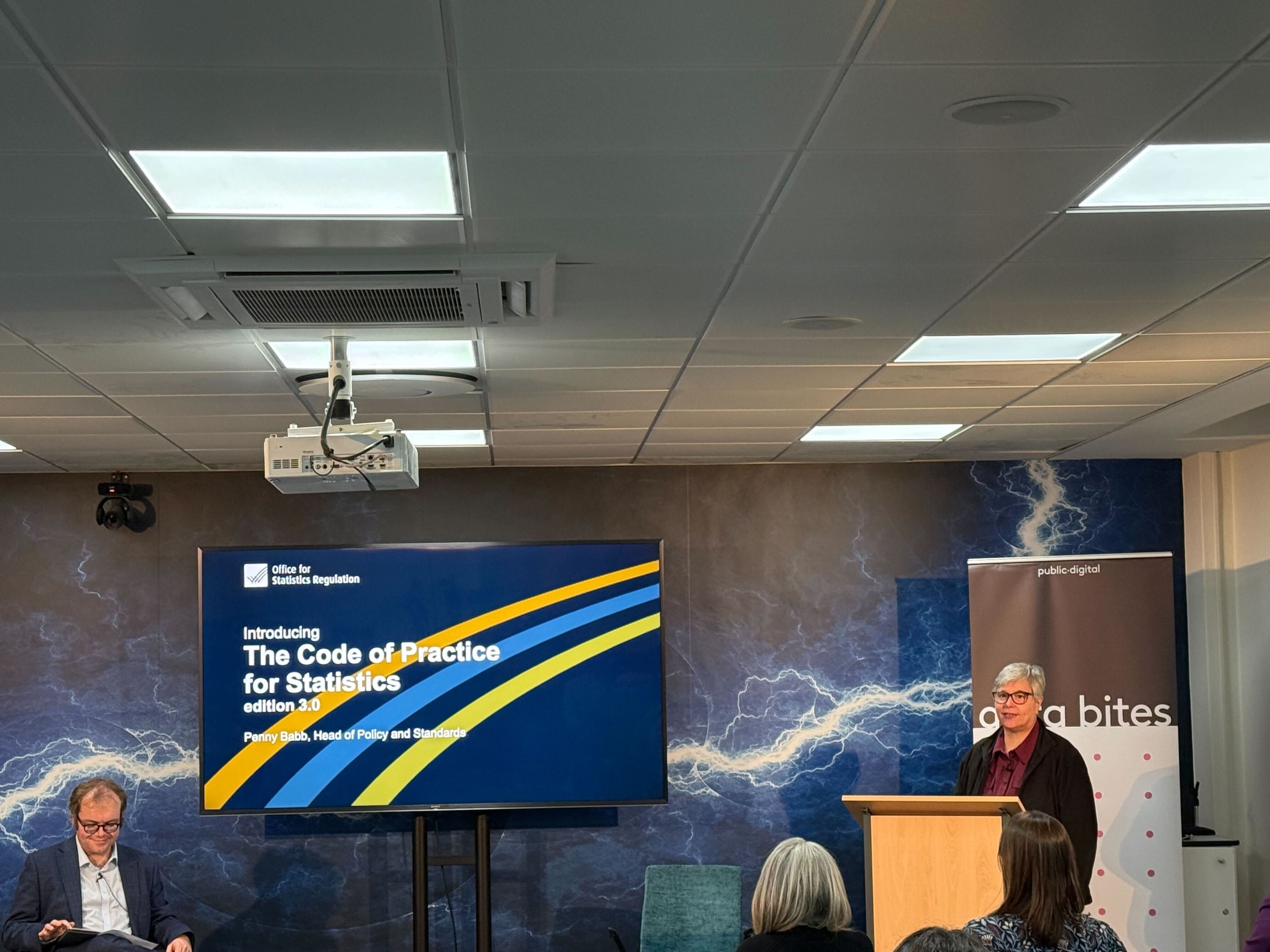
Penny Babb, Head of Policy and Standards at the Office for Statistics Regulation, presented on the new Code of Practice for Statistics, which was launched on 30 October. Penny previously presented at Data Bites 45 (in September 2023) on the review of the Code. As well as the Code itself, there’s a tool for analysts and data scientists, and a voluntary application scheme.
Penny has answered our standard questions and some questions from Slido below:
Can you summarise your project in a few sentences?
We’re introducing edition 3.0 of the Code of Practice for Statistics, an ethical and actionable framework built around Trustworthiness, Quality, and Value (TQV). It’s designed to help analysts and producers embed integrity, transparency, and user focus into everyday work—not just as a compliance tool, but as a practical mindset.
What problem are you trying to solve?
The perception that the Code is a rigid rulebook rather than a useful tool. We want to show the Code is a thinking tool that guides everyday decisions, ensuring statistics are trustworthy, high-quality, and valuable.
What difference will it make to citizens?
Citizens can have confidence in the integrity of official statistics and those producing them, leading to better-informed decisions and the ability to hold government to account.
How will you know when it’s succeeded?
When the Code is widely adopted, analysts consistently “think TQV”, and statistics are trusted and used effectively by the public, with positive feedback and engagement.
What are the main hurdles?
Changing the perception of the Code from a compliance checklist to a practical guide.
Embedding the mindset across diverse teams.
Overcoming resistance to transparency in sensitive contexts.
If you could change one thing about data in government, what would it be?
Make ethical, transparent, and user-focused data practices the norm, so every statistic and analysis is produced with integrity and clarity.
From Slido:
Which is your favourite standard?
1. Show integrity: Producers must act with integrity, working and communicating in honest, objective and professional ways, and challenging misuse, as it wraps up everything in one statement.
How would you measure public confidence in your statistical code? Would you be using any metrics to measure that?
OSR has just released its new strategy – a key part of that is looking at impact of embedding the Code so that it will provide an important means for evaluation. We will be releasing an evaluation plan about how we will monitor our delivery
Who should see the code, but you have struggled to engage?
The Code can come over as only of relevance to statisticians so reaching out to others particularly members of the public and journalists can be tricky.
What challenges did you face in setting up this new code of practices?
There are a range of different perspectives and needs among our stakeholders which at times may appear competing. Ultimately though they all are committed to statistics serving the public good. Listening to these to find a way that respects the various needs but clearly sets the standards to adhere to has been central to our challenge.
The new ethics and integrity commission will be promoting codes of conduct in all public bodies. How can professionals find synergies between two frameworks?
One action we can take is raising awareness about the Code, OSR and the new Standards for Public Use with other ethics bodies given the importance of using stats in decision making
Do privacy issues or existing legislation such as data protection and GDPR apply to using the statistical code?
Yes – there are aspects of working with personal and commercial data where producers need to work in line with legislation. The Code reflects this in our standard related to managing data responsibly.
Are you or Ed [Humpherson, head of the OSR who presented at Data Bites 55] presenting the Code to Ministers?
No but we wrote to ministers to invite their input and have recently written to them to flag the release of the new edition of the Code. In particular, we flagged the inclusion of the new standards for the public use of statistics, data and wider analysis which relate directly to ministers and their officials in how they communicate using statistics.
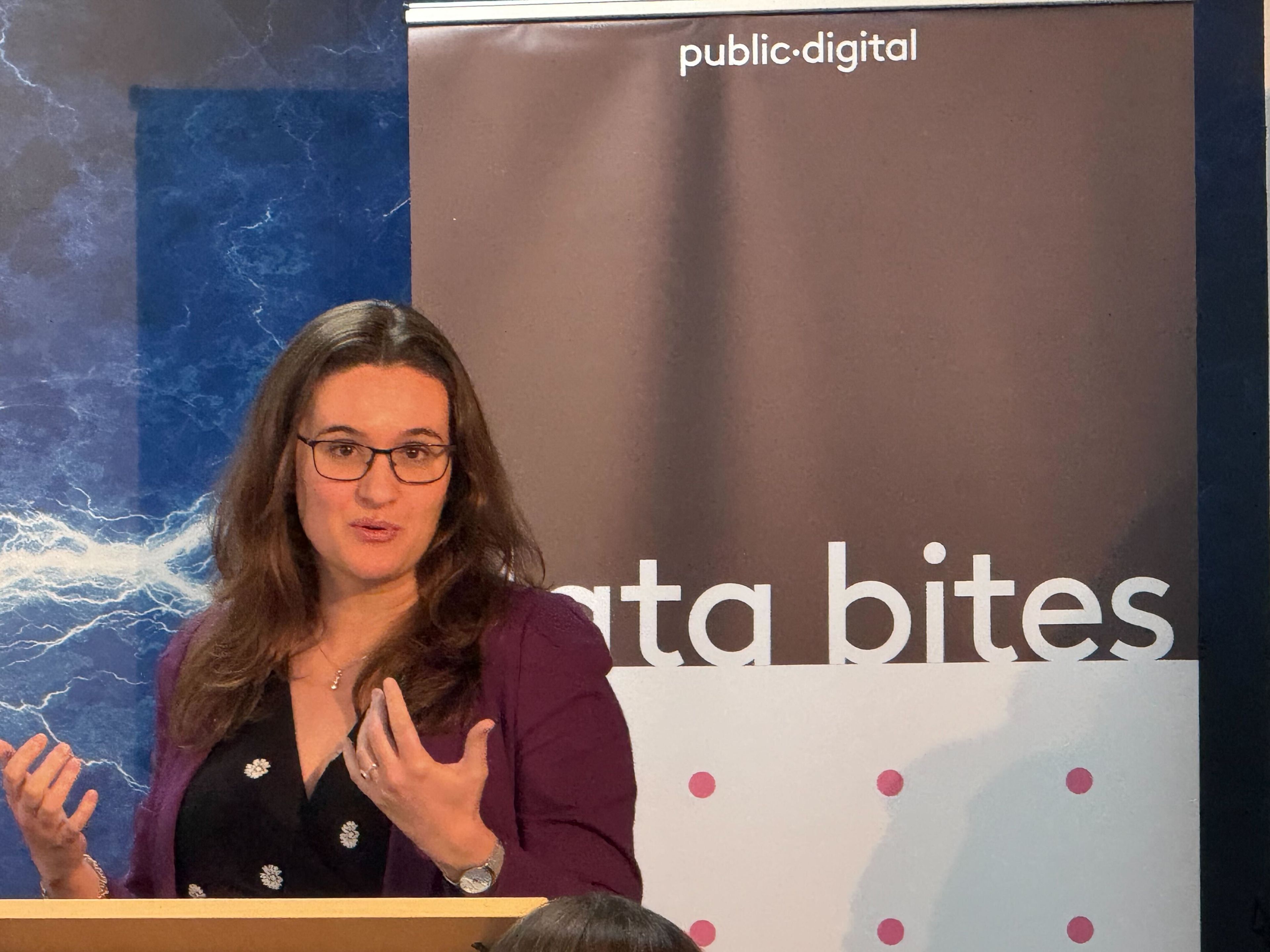
Martine Wauben, Head of Data for London, Greater London Authority, spoke about the Data for London Library, how it has grown from earlier initiatives (such as the London Datastore and London Data Week) and the importance of collaboration. Martine encouraged everyone to explore the Library.
Data Bites has previously heard from the GLA and London Office of Technology and Innovation on data sharing across London (2020), and about the GLA’s High Streets Data Service (2023).
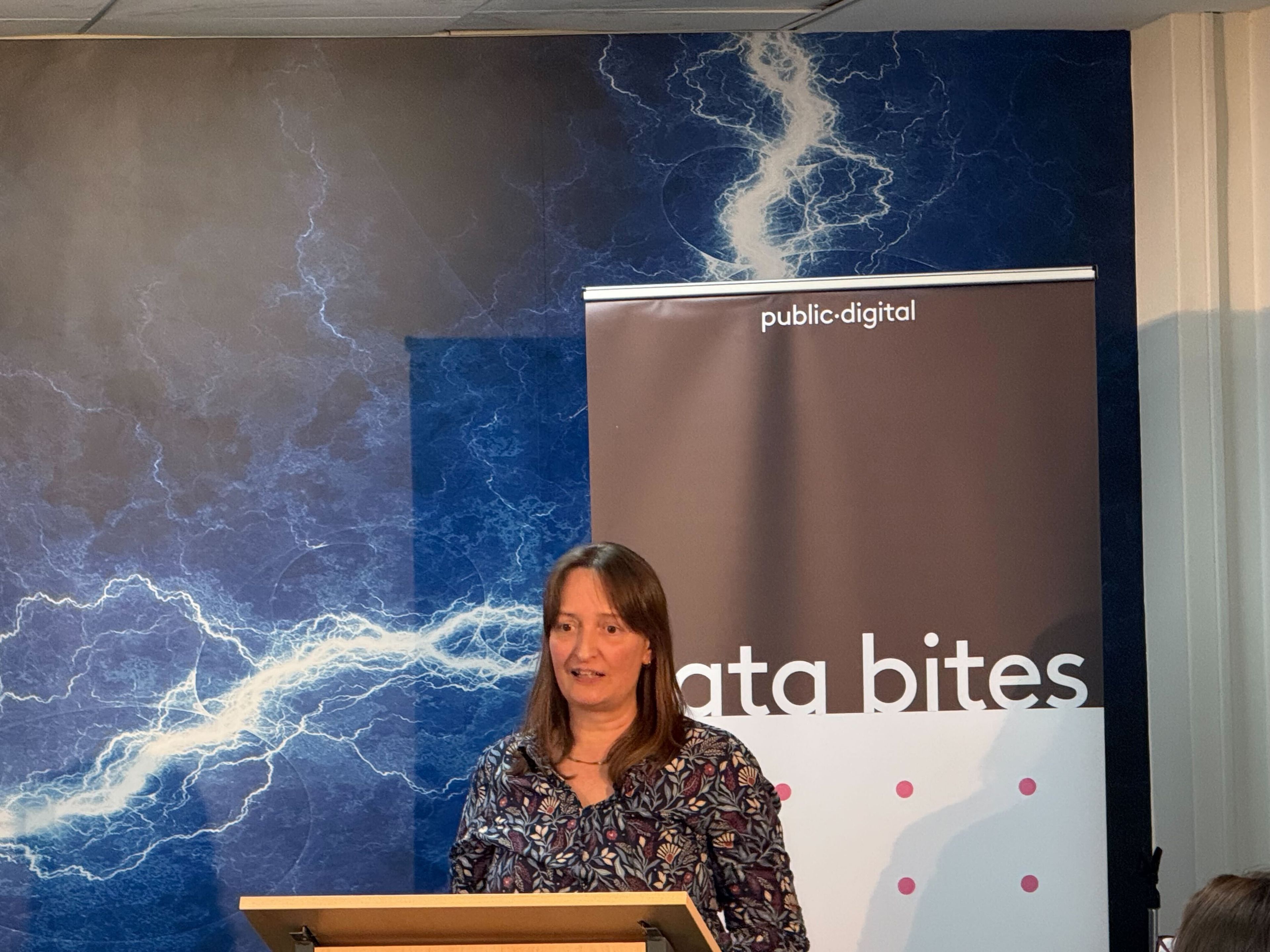
Michelle Waters, topic consultation lead, Office for National Statistics, spoke about the Census 2031 topic consultation and the importance of gathering user insight to shape the next census in England and Wales. The consultation is open until February 2026, and Michelle encouraged people to contribute. She also answered our standard questions:
Can you summarise your project in a few sentences?
The Office for National Statistics (ONS) has launched a public consultation to help shape Census 2031 in England and Wales.
We invite you to complete our topic consultation, before it closes on 4 February 2026. Your input will help ensure Census 2031 reflects the changing needs of people, communities and organisations across England and Wales. By taking part in this consultation, you’ll help shape the topics we include; so the data we collect supports better decisions, stronger communities, and a clearer picture of how people live and work.
Alongside the topic consultation, the Government Statistical Service has also launched a consultation, asking for views on additional tick box options for ethnicity data. We encourage users of ethnicity data to complete both consultations.
What problem are you trying to solve?
The topic consultation is designed to collect enduring and emerging needs for the Census 2031 in England and Wales, to make it a valuable data asset to support decision making across sectors.
What difference will it make to citizens?
Census 2031 will touch all of our lives, through the decisions it will support.
Citizens and community groups can shape the census content directly by responding to the consultation.
How will you know when it’s succeeded?
We will publish the outputs from the consultation in 2026, a high level summary of responses in April, followed by the full evaluation in late summer.
If you could change one thing about data in government, what would it be?
Better coherence across government datasets.
Some key links include:
Michelle was also asked a question relating to the voluntary Census question on sexual orientation. She wasn’t able to answer fully, but suggested that this from the ONS, which sets out the work that was done on testing the sexual orientation question ahead of the 2021 Census, might be useful. And we heard about the previous consultation into the future of the Census at Data Bites in 2023.
If you’d like to keep up to date with plans for Data Bites in 2026, you can sign up for updates on this page. In the meantime, have a wonderful Christmas and an excellent start to 2026.