Delivering the UK Government’s Test, Learn and Grow programme
View client story
With Andy Burnham in his sixth week as UK Prime Minister, and 14 more areas recently announced for Local Government Reorganisation, devolution is high on the agenda for the UK government.
At PD we are proud to be supporting local government and mayoral strategic authorities (MSAs) through this era of public sector reform, including in our partnership with Dorset Council to help them transform into a modern sustainable unitary authority, applying product-led, test and learn methodologies to streamline services and improve outcomes for residents and staff.
As part of that, we’re working closely with Dorset Council’s Chief Executive, Catherine Howe. Catherine brings an unusual background spanning technology, community and social change. She is former CEO of Public-i Group Ltd, and led digital transformation at both Capita and Cancer Research UK.
In this interview we hear her take on devolution, AI, and her work in Dorset.
In your recent MJ piece on devolution, you talk about the need to give councils space to breathe. How can central government best provide that, and why does it matter?
"It's two things. First, if you genuinely believe local places are the right decision-makers, you have to give them time to work out what they want to do with the power, rather than dictating it. We're no longer arguing for devolution, we're deciding what to do with it, and that takes time to think through.
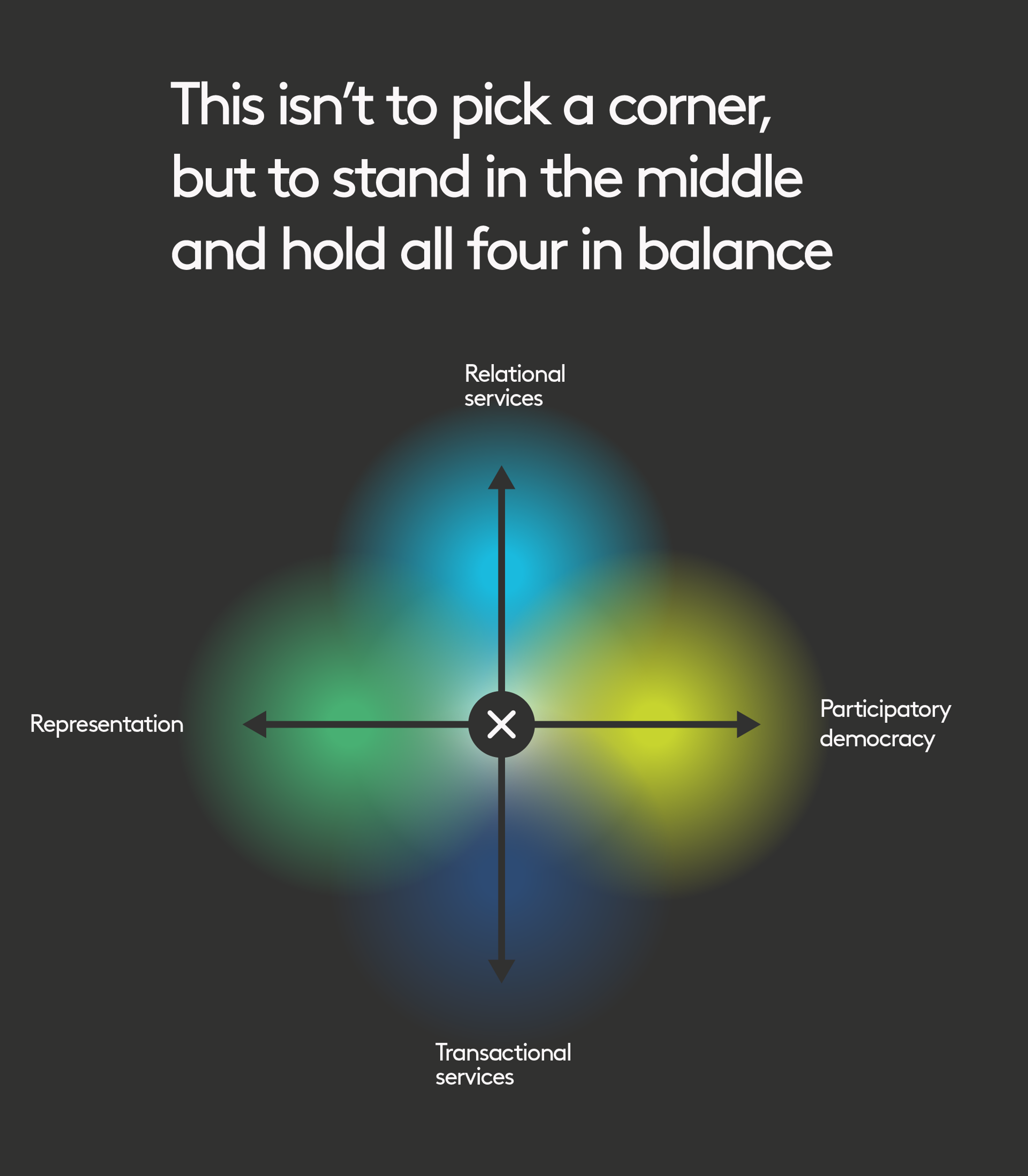
Second, it means letting the democratic mandate do its job. Alongside rewiring the state and modern public services, there has to be real attention paid to democracy, and not just through participatory initiatives such as pride in place. A pile of performance measures about potholes undermines any genuine conversation about empowering communities - because empowering communities while disempowering their elected representatives makes no sense. One of the biggest questions here is whether central government can learn to trust that process."
Given recent pronouncements from the government, how far do you think that message has actually landed?
"You can feel civil servants snapping to - but it feels from the outside that they're accelerating the bits they understand rather than checking they've grasped the deeper opportunity. My worry is a rush toward the mayoral-authority model in the areas that fit that already, because that's the version Whitehall knows. It doesn't map onto somewhere like the South West, which is a complex, polycentric economy with little co-terminosity (where the geographic boundaries of different public bodies line up with each other).
The civil service doesn't know what it doesn't know, which is why the Test, Learn and Grow programme matters: it should produce iterative experiments with Whitehall and Local Government working as partners."
How much time might that space need, and how should it change over the coming months?
"Whitehall needs to learn to contract over time rather than in announcement cycles. Going slower in the design phase should let you go faster in execution, but everyone needs to buy into that, not treat it as a delay. Right now, I would argue that government isn't set up for proper design work. For example, the Home Office is preparing a policing white paper which seems to be entirely disconnected from the trajectory to implement the mayoral strategic authorities that will hold democratic responsibility for policing. That kind of disconnect can't stand if we are to achieve what is outlined in the Rewire the State document. The civil service needs to treat design as a necessary discipline and give places parity of esteem within it, or you risk getting unworkable diktats."
What's front of mind for how Whitehall itself needs to adapt to make devolution work?
"A few things. First, understanding a different mode of delivery - state capacity, and design as a core skill set. At a recent South West Council’s event we started talking about "Whitehall for the West": if there's Number 10 for the North, we want regional reps from every major department engaging with the space that the four South West mayors will eventually occupy. This is not a recreation of regional offices but the chance to be a meaningful participant in the local system. That helps the civil service think in place rather than in silos, and in the context of economic development, gives the industrial strategy a place lens instead of the (in my view) unhelpful sector lens it started with.
There's also a question of where public service reform is driven from, tangled up with decisions around the Government Digital Service and technology. There's no future state that isn't tech-enabled, and no serious growth without sovereign tech capability - yet we're not pulling those pieces together despite investing heavily in AI. Reform can't just be about turning citizens into better consumers; it has to be about good growth and a genuinely more relational state."
"On AI: Step One should be for AI to eat the work, because we're doing loads of work we don't need to do (mainly generated by badly designed technology!). Step Two is to continue to eat the work so that we can be more human: so my call handlers don't have to limit themselves to 6 minutes on a call, they can spend as long as they need to to make that person feel heard and supported."
Stuart Hoddenott of the IFG argues boundary alignment should be the first test for devolution. Do you agree?
"My first test is simpler: to push the button, and let some of us go. Take the shackles off the priority programme, and actually give councils an MSA. Waiting for perfect co-terminosity with Integrated Care Boards, or for the policing white paper to reflect mayoral boundaries, would delay everything. Boundary alignment matters, but it has to be a fast follow alongside action. Without a shared vision for why alignment matters, you're just fighting over lines on a map.
That vision starts with being clear about the unit of change: MSAs are the unit of public sector reform. Once that's agreed, boundary questions become easier to resolve."
The bottleneck in digital government used to be practitioner capability. Is it shifting to judgement?
"Yes. There's a kind of craft apprenticeship here - moving from spreadsheet-level thinking to genuinely exercising judgement - and government has generally been poor at cultivating it.
Donella Meadows' work on system leverage points is really helpful here in focusing us on what has the biggest impact when you are trying to shift a system: in the work we are doing we see the biggest shifts come from treating work as a prioritised backlog rather than an endless in-tray, and seeing the organisation as a living system rather than a machine. Participation has to become a practised skill, data underpins judgement, and complexity can only be faced through iteration. These are big changes to people’s mental model around what public services look like.
The pay off is potentially huge; Once you achieve that mental shift, I don't just have a transformation team making change happen, I have 5,000 people who just get it. So I'm obsessed with the question: how do you help people move their mental model? And going further, how could you go to each of the professions that sit in the civil service and say, how does your mental model change now?"
What's a favourite example of your work from the last year in Dorset?
"Resurveying a sample of the workforce and seeing people genuinely feel the organisation changing - not glowing everywhere, but engaged and honest about what's working.
On the way out of one session, a security guard stopped me to make the suggestion that housing support for ex-offenders should start a month before they leave prison, because so many arrive with nothing but a bag and enormous stress. It was a brilliant idea, and exactly the sign of an organisation that wants to solve problems and feels able to say so."
Who do you see as your nearest peers in this work? Who do you take inspiration from?
"What Kate Josephs is doing in Sheffield is genuinely interesting, and Cornwall has done extraordinary things - there's excellent work happening in pockets everywhere. What frustrates me is the absence of a common blueprint connecting central and local government - a shared theory of change that ties those pockets together. People like Evie John and James Plunkett are wrestling with exactly that problem, and that's where I draw my inspiration: the sense that this blueprint has to be consciously designed, not left to emerge by accident.
I hope what we're doing here in Dorset is one signal among several that could feed into that blueprint."
What's the most, and least, impactful thing Andy Burnham could do right now for devolution?
"Least impactful would be just rearranging Whitehall rather than getting out into the places devolution is meant to serve. It is thinking power that needs to move outward, not just money.
Most impactful would be showing up in areas without a mayor yet - the South West, Sussex, other non-metro regions - and demonstrating that devolution means respecting the place, not just the political office. The most symbolic thing the PM could do is to sit down with areas to accelerate their devolution journey.
Until those areas get the same parity of esteem, devolution will keep looking like a northern, metro-mayor story rather than a national one."

Chief Executive, Dorset County Council