Operating model
We help organisations design and adopt operating models that let them respond to ever-changing customer needs.
Read more
If you’re a leader responsible for improving service outcomes in your organisation, it's tempting to assume you need to start with a big ‘transformation’.
Moving customers and internal users from old legacy processes to new technology and ways of working can have a massive impact. However, it's not the only way to improve outcomes, and might fail if you’ve not considered smaller, service-level change first, or if you don’t have the right conditions in place.
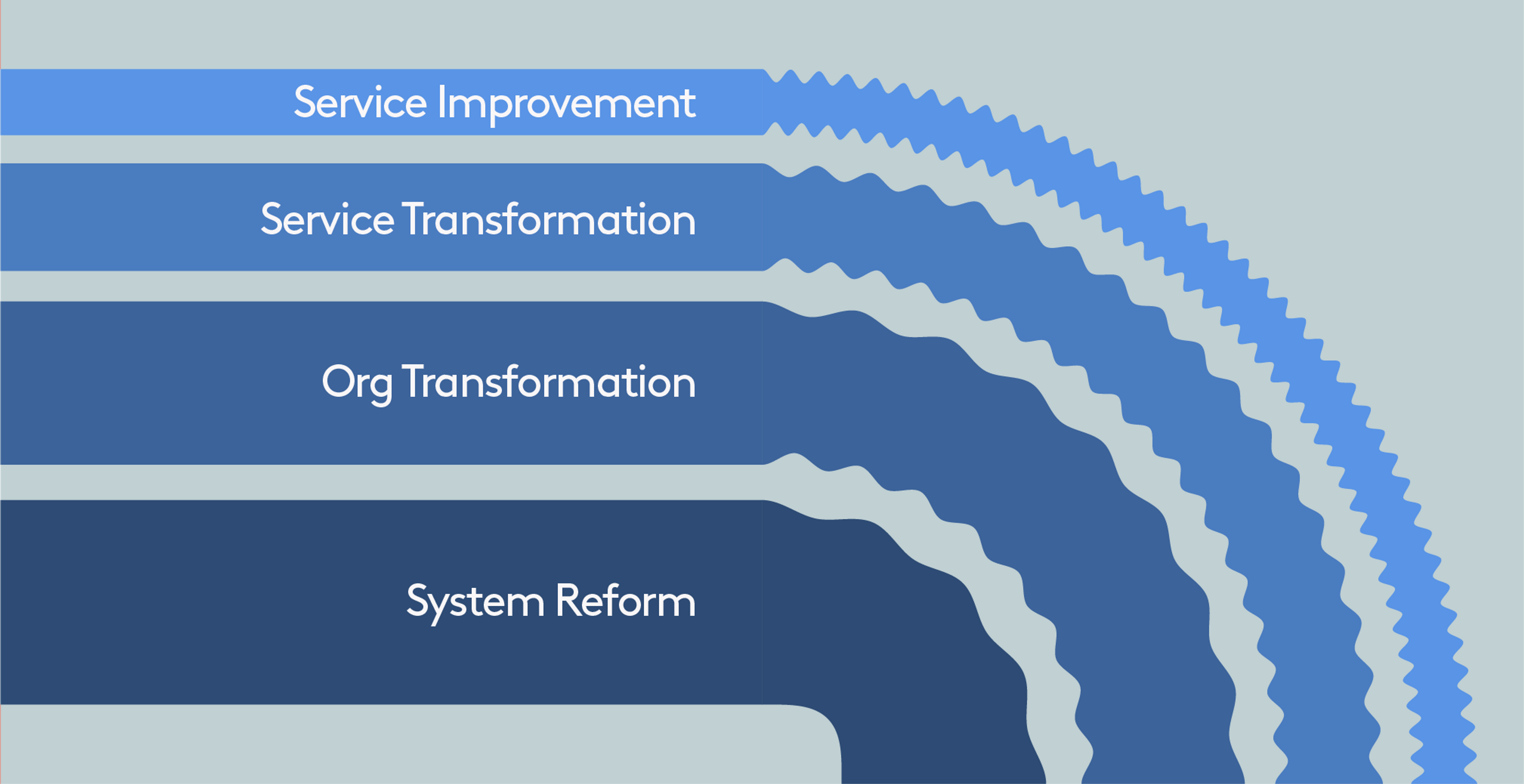
Working out where to invest limited time and capacity is a tough decision, but from our experience there are four different ‘levels’ of change that clients should consider:
1. Service Improvement: Iterating the touchpoints within the current service structure.
2. Service Transformation: Taking a wider view to transform the service, considering an ideal future state.
3. Org Transformation: Changing the structure and culture of the organisation to set it up to deliver multiple services differently.
4. System Reform: Participating in a wider movement to transform the conditions in which your services operate.
Instead of assuming that service or org transformation is always the answer, it’s worth pausing to explore which of these levels would provide the most value for your organisation, and whether you have the conditions in place to make change happen at the relevant level.
Let’s explore these different levels through the example of an appointment-based service, such as for a healthcare or financial services provider.
The desired outcomes for the user or customer are:
Better outcomes, with fewer appointments
Feeling treated as a person with their own needs
The desired outcomes for the organisation are:
Fewer no-shows
Greater adherence to advice between appointments
Customer retention
Combined, these are expected to result in lower customer acquisition costs, increased customer and colleague satisfaction, and efficiency savings through less failure demand.
Starting with the assumption that the service is currently a manual, paper-based service, we’ll explore the four levels of change and the organisational conditions needed for each to be successful.
This level focuses on improving the desired outcomes within the current service constraints and its existing service artefacts and tasks. In our example, this might involve changing the language, timings and frequency of follow-up letters after appointments.
The foundation of all this work is carrying out user research, effectively gathering insight through observational research, and applying it to make improvements. That demands:
A focused team who care about users achieving their goals, with the time and humility to gather feedback, understand the issues and spot opportunities for improvements
User research and content design skills combined with operational experience
Collaborative operational, legal and information governance colleagues who will support changes to existing content
Recognition from leaders that improvement of existing services should be a priority, rather than treating them as ‘BAU’ with no need for investment.
At this level, you are no longer looking exclusively for improvements within the constraints of the existing service, but are reimagining how the service operates.
This could include introducing a CRM tool to automate SMS reminders, or designing a digital service that monitors progress between appointments.
This work still requires the research and content design skills in collaboration with operational colleagues from level one, but on top of that, it is likely that you will need:
Someone with experience scoping technical feasibility and interoperability between systems (even if you don’t need to ‘build’ anything)
Someone with service design skills who can convene the right people and paint a picture of the desired future state
Someone with delivery management skills who can take the time to understand the details of how to achieve that future state
Collaborative commercial colleagues who can support with ‘agile procurement’ of new technology like SaaS products.
As teams start to transform services, they will find aspects of the structure and culture of the organisation that prevent them from fully realising their intent. This can be the technology people use, the way teams are funded, or how teams collaborate.
For example, teams might discover that the only way to improve a service is to start a ‘change programme’ which requires a business case and governance, slowing them down. Convoluted change processes incentivise people to keep working around current processes rather than try to resolve root causes.
Alternatively, it might be necessary to significantly change the culture. In our example, transformation might involve shifting the incentives of staff by rewarding behaviours that prioritise achieving customer outcomes as quickly as possible.
All of these factors, sometimes collectively known as an organisation’s operating model, will have a major influence on any organisation's ability to transform its services, and support the desired way of working. Transforming at the organisational level often demands:
New team shapes and sizes
Re-thinking how governance supports change. This should be applied to both the front line of the service, and those working behind the scenes to improve it
Breaking established norms around ‘change’ vs ‘run’ budgets to empower teams looking to continuously improve services
New skills: Those experienced with different governance, funding and incentive structures, in particular experience changing organisation structures with people - rather than making change happen to them. These skills might be represented by service designers, coaches, enterprise architects or change specialists.
This work can be complemented by the previous two levels. In fact, it is often only by attempting the previous two that you can really have an informed view of how an organisation needs to change.
Almost all transformation reaches the point where service outcomes are no longer entirely within the organisation's control, but are instead determined by a wider eco-system of services and policies.
For instance, you might discover that the way people interact with your services is affected by factors such as digital poverty, health inequalities, housing insecurity, or deeply held societal biases. In our example, people who are under-employed may not attend an appointment if they struggle to prioritise it over the offer of an additional work shift.
Similarly, your teams might discover (often too late) that they are limited by current legislation or a regulatory body.
At this level you need:
Information gathered during your attempts to transform your services and organisation, which highlight the benefits to the people using the service
People with experience in influencing other organisations, and who can work pre-emptively, before you’ve tried to launch a service. These people could have policy, communications or PR backgrounds.
A clear conviction of the services your organisation provides, and willingness as leaders to join and form networks of other leaders looking to achieve similar things.
A strong understanding of these levels - and the ability to identify when jumping straight into ‘service transformation’ might not actually be the right approach - is what distinguishes mature digital leaders from those trying to implement off-the-shelf frameworks. Having the language to articulate what level the work you are doing is, and why you made the decision to take that approach, will help you win continued support and budget.
For many leaders trying to transform their services, progress stalls as the initiative travels up the four levels, and as the lack of commitment to or experience in the transformation needed becomes apparent.
For that reason, working at the lower levels is vital to laying the groundwork for moving upwards. Transformation moves at the speed of trust, and demonstrating the value of new approaches through service improvement builds that trust and generates the necessary momentum for broader transformation at scale.
If you want to build the conditions to make change happen in your organisation, get in touch at workwithus@public.digital

Director