public digitalThe public digital logo

Dynamic Operating Model

In a world where people’s needs and expectations change faster than ever, organisations must be able to adapt at pace.

The Dynamic Operating Model enables that adaptability.

It embeds a test-and-learn approach into the organisation’s DNA—shaping strategy, funding, roles, and governance around evolving user needs and changing conditions. More importantly, the model guides behaviours, not just structures, and informs a culture that supports continuous learning, collaboration, and agility.

The result is an adaptive organisation that responds quickly, experiments continuously, and turns changing needs into lasting advantage.

9-DOM-alpha_2025-12-17-144528_dymp.png

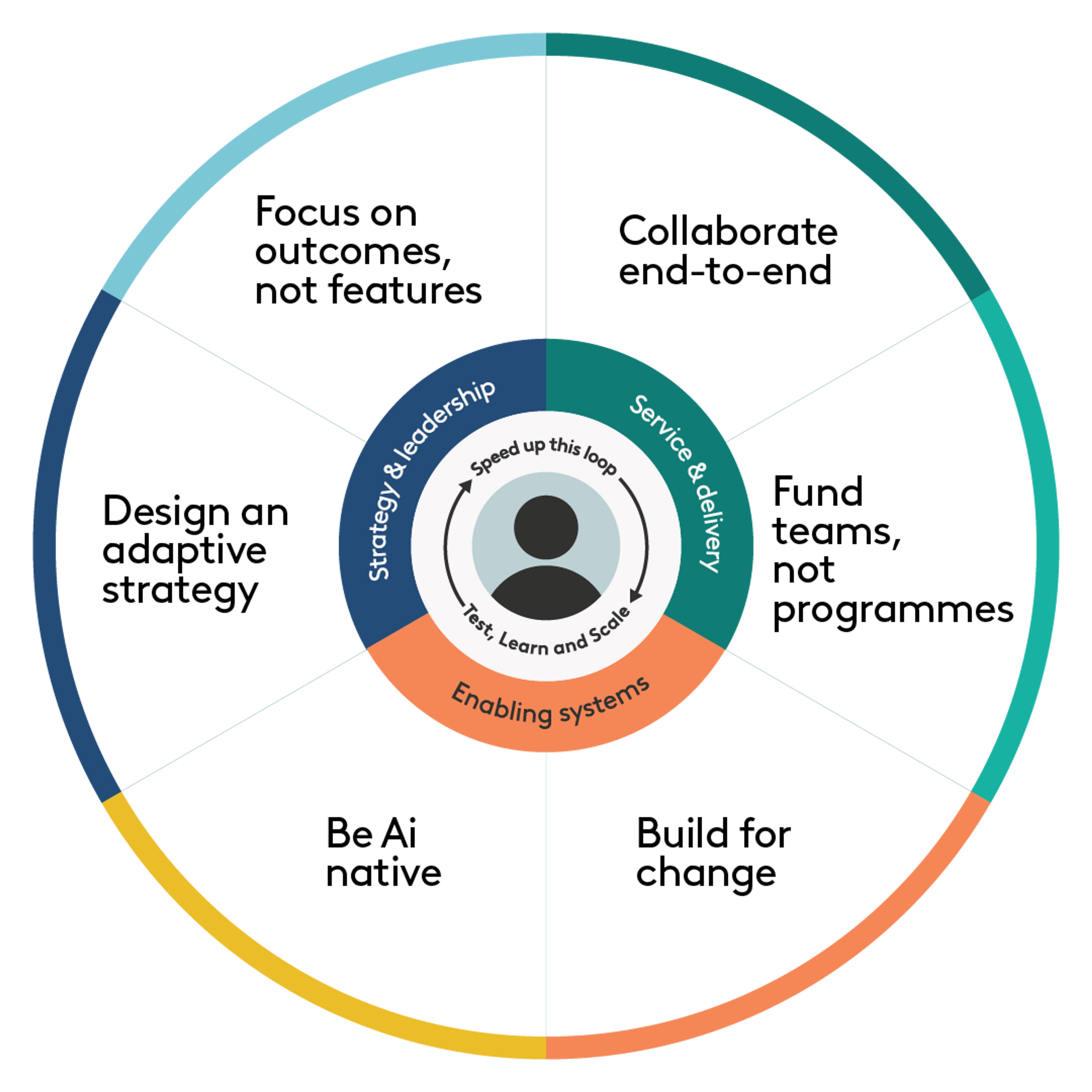
Strategy and Leadership

  • Design an adaptive strategy

    Shape a strategy that learns and adapts to evidence, feedback, and shifting conditions.

  • Focus on outcomes, not features

    Clear outcomes guide decisions and empower teams. Control stifles progress and limits impact.

Service and delivery

  • Collaborate end-to-end

    Multidisciplinary, cross-functional teams collaborate across services, combining human and Ai skills to deliver secure, compliant, human-centred outcomes.

  • Fund teams, not programmes

    Funding stable teams, not fixed programmes, enables goals to evolve with changing priorities and user needs.

Enabling systems

  • Build for change

    Systems and processes adapt as the organisation grows, with short-term contracts to avoid legacy constraints.

  • Be Ai native

    Ai is integrated across the organisation, embedded in everyday systems and workflows to amplify human judgment, and accelerate outcomes.