PD Newsletter #109: Devolution, with guest editor Catherine Howe
👋🏽👋🏻👋🏾 Hello, welcome.
With Andy Burnham in his 6th week as UK Prime Minister, and 14 more areas recently announced for Local Government Reorganisation, devolution is high on the agenda for the UK government.
This bumper special edition is co-edited by Catherine Howe, friend of PD and Chief Executive of Dorset Council. She shares her takes on devolution, AI, and the future of local government. Read the full interview.
View this newsletter on LinkedIn
Forwarded this email? Sign up
🌱 PD and local gov reform
🏛️ We’re proud to be a partner on an initiative by Bloomberg Philanthropies to build the capacity of the UK’s new Mayoral Strategic Authorities (MSAs).
🔄 We’re also working with Dorset Council to help them transform into a modern sustainable unitary authority, applying product-led, test and learn methodologies. Last month, we went to Local Government Reorganisation (LGR) camp and shared Dorset’s Test and Learn work.
💡In June we facilitated the SW’s Test and Learn network, sharing the principles and practical steps for applying test and learn to service delivery.
🇬🇧 Context: The decentralisation challenge
The UK is one of the most centralised governance systems in the world:
- Almost 92% of all government revenue flows to Whitehall
- Central government in the UK represents 80% of total spending, in contrast to countries like Denmark where local government controls around 65% of public expenditure.
- Evidence points to the higher economic growth and living standards that come from decentralisation and fiscally empowered regional governments. For instance, research shows that Germany’s institutionalised multi-governance systems handle regional imbalances better than centralised systems like the UK’s.
🧠 Devolution: changing the role - and mindset - of the centre
Devolution does not mean the centre disappears, but it does mean that its role and the way it behaves will need to change. As Catherine argues, the centre needs to give councils the space to breathe. “For local government, the first test for the new Prime Minister is to just push the button, and let some of us go.”
“Devolution is respecting the place, not just the political office… So the most symbolic thing the PM could do is to sit down with areas to accelerate their devolution journey, not just to pat mayors on the head and say, I love what you're doing.”
This change from the centre requires a mindset shift: “The problem is the civil service doesn't know what it doesn't know. And this is why I think the Test, Learn and Grow programme is so important in terms of how it is injecting a modern mindset into the civil service. The civil service mustn’t try to come up with grand plans. It's got to come up with a lot of iterative experiments and then go back to teams and ask: is this what you meant? Does this feel all right? Is it helping?”
The PM announced last week that Whitehall officials will be seconded into mayors’ offices - a positive step forwards in beginning to expose civil servants to the front line and support this mindset shift.
🏗️ Building local capability and accountability
Devolution means more than handing over spending power and hoping that innovation follows. It requires the fundamental rethinking of the relationship between local and central government. Combined authorities, councils and MSAs need to be supported and ready to take on the new responsibilities that devolution promises.
➡️ Unlike simply devolving funding, capability needs to be built, practised, and sustained - with deliberate investment.
➡️ We need to build state capacity - capacity to adapt, learn, collaborate and convene - at every level, in every part of the country.
➡️ For funding and decision-making to be truly devolved, authorities need to be supported by central government to embed the principle of 'locally accountable autonomy’.
➡️ The GLA’s Theo Blackwell has written that government departments need to release specific datasets to strategic authorities and councils to enable effective devolved decision-making powers.
➡️ Public Digital called for much of this last year in our joint report with The Future Governance Forum.
Building capability and accountability won’t be a one-size fits all. Not all regionalities have the opportunities of Manchesterism - rural counties, coastal towns and post-LGR unitaries may not have Greater Manchester’s institutional muscle memory, scale, or a decade-long head start. And it's vital that we remember that Manchester’s solutions are not necessarily everyone’s solutions. Burnham’s government must be ready to support every region to build capacity, explore their own context and enable place-based transformation.
🤝 Collaboration and co-terminosity
Collaboration is essential for devolution to succeed. We have written about the importance of cross-authority collaboration, and for the responsibility for outcomes to be devolved to the level where levers are most aligned. Catherine highlights that to do this, “we need a strategic space where we come together - the delivery engine is the mayoral authority.”
She also calls for practical alignment between MSA boundaries and other public bodies - such as the police and Integrated Care Boards - so that mayors can actually take hold of the levers needed to drive change and local growth:“That co-terminosity enables people to work together, understanding that they’re part of the same system”.
While Stuart Hoddinott has warned about the consequences of haphazard geographic boundaries, we’ve seen pockets of devolution in respect to public health, with certain elements of health funding and responsibility also being devolved to the Greater Manchester Combined Authority and to Cornwall.
In 2013 the Scottish Government redrew health board catchment areas to align with council boundaries, ensuring health and social care systems work together effectively to improve the provision of care in communities.
🔀 The relational state
Catherine argues relational and transactional services, alongside participatory and representative democracy, are four points of tension that must be carefully balanced rather than treated as separate silos.
“An answer to a more relational state, and better democracy, doesn't sit in Whitehall. It's got to be in partnership…. You've got to get the right balance between participation and representation [democracy], and you've got to get the right balance between transactional and relational [services].”
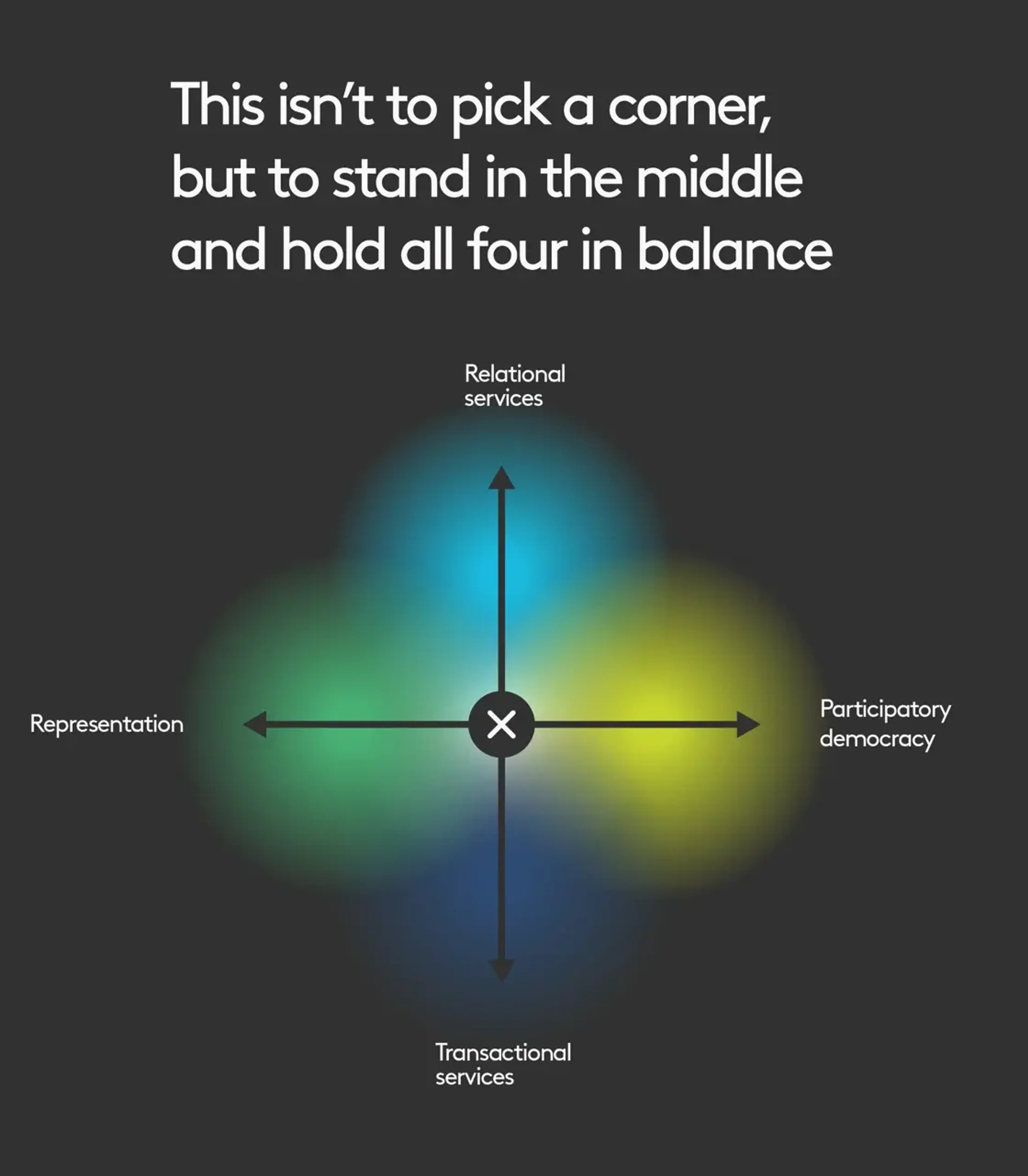
Without this balance, people are left either “unable to participate effectively or feel treated as mere consumers, rather than empowered citizens”.
🪴 Evie John from Inner Circle Consulting has written about how devolution can enable this different model of governing, that is “relational, networked and rooted in place.”
⚡ PD’s Andrew Greenway has argued central and local government should practically apply a variety of place-based, relational practices and mindset shifts.
🤖 The role of AI
Catherine advocates for using technology to automate routine, "transactional" work, which frees up staff to provide the empathetic, "relational" support that citizens truly need.
“Step one should be for AI to eat the work, because we're doing loads of work we don't need to do. Step two is to continue to eat the work so that we can be more human: so my call handlers don't have to limit themselves to 6 minutes on a call, they can spend as long as they need to to make that person feel heard and supported.”
Tom Loosemore has also been arguing AI agents are about to transform what is required of public services, and organisations must be equipped to handle agents accessing digital services on behalf of people.
🌟 Leadership and transformation
The key to Catherine’s work in Dorset is trying to create a mindset shift in how the council thinks about change. She points to Donella Meadows' work on system leverage points, and how the biggest shifts come from treating work as a prioritised backlog rather than an endless in-tray, and seeing the organisation as a living system rather than a machine.
“Once you achieve that mental shift, I don't just have a transformation team making change happen, I have 5,000 people who just get it. So I'm obsessed with the question: how do you help people move their mental model? Going further, how would you go to each of the professions that sit in the civil service and say, how does your mental model change now?”
Catherine has written extensively about leadership in this era of public sector reform, and shares more of her thoughts in our full interview.
📚 What else we're reading
- Kate Josephs, Chief Executive of Sheffield City Council, on why central government must loosen its grip on local authorities.
- The LGA's LG2040 "State of Things to Come" report frames the same territory as Catherine: political leadership, organisational capability, and community partnership as three interlocking forces shaping future outcomes for authorities.
- How the Netherlands’ uses relational local services to tackle the challenge of NEETs.
- Hamida Ali of the Future Governance Forum on why Burnham’s government still needs a cultural reset.
- Towards a Relational State by Marc Le Chevallier, Nigel Ball and Polly Mackenzie highlights the current ideas, organisations and initiatives shaping the field of Relational Public Services
- Councils’ LGR stories:
- Cumbria’s lessons learnt (presented at LGR Camp) after their reorganisation in 2023
- Dorset Council's lessons learnt (presented at LGR SW Camp by Lisa Trickey, previously: Head of Digital Strategy and Design Dorset Council) after their reorganisation in 2019.
Top posts from newsletter #108
1️⃣ Forms don’t love you back, Rachel Coldicutt
2️⃣ Updating my definition of digital, Tom Loosemore
3️⃣ Building adaptive organisations: a reading guide, Sarah Taraporewalla