
AI consulting
We help organisations get real value from AI by readying their teams, services and governance, and building leadership confidence.
Read more
In our recent work with the Government of Barbados, we built an AI colleague, Bimstack, to embed long-term user-centred design capability within the team. Here, we look at how we did it - and how it’s changing the way the team works.
There is no shortage of theory about how AI will change government.
In our work with GovTech Barbados, we have moved on from theory to real-world impact: forming AI-augmented teams and putting them to work on real public services.
This new AI colleague is transforming how the team works - plugging skills gaps, helping them move faster and learn faster, and enabling the kinds of constructive conversations the team needs to make rapid progress.
Why build an AI colleague?
The idea came out of one of the goals for our work with GovTech: to help them hire the typical roles in a digital delivery team: design, research, product, delivery, engineering.
While we successfully recruited local engineering talent, we struggled to hire practitioners skilled in user-centred design (UCD).
Having leant on the expertise of PD staff who were skilled in UCD to help bolster the team during our time together, we wanted to ensure the relevant skills were sustainable and embedded within GovTech. So we started to ask ourselves how we might leave the team with those skills once our work with them was over.
Inspired by Garry Tan’s GStack, we built Bimstack.
What does Bimstack do?
Bimstack is an open source plugin for Claude which bundles skills and agents for delivering government digital services in the GovTech Barbados house style, covering the whole lifecycle from discovery (problem statements, research plans, ecosystem and journey maps) through to build, iteration, production readiness and self-assessment against the 13 Barbados Digital Service Standards.
It has been trained to do a range of roles: service design, user research, product management, delivery management, software development and interaction design. Each of these ‘roles’ have also been equipped with a number of skills - for example, stakeholder mapping, writing weeknotes, prototyping, etc.
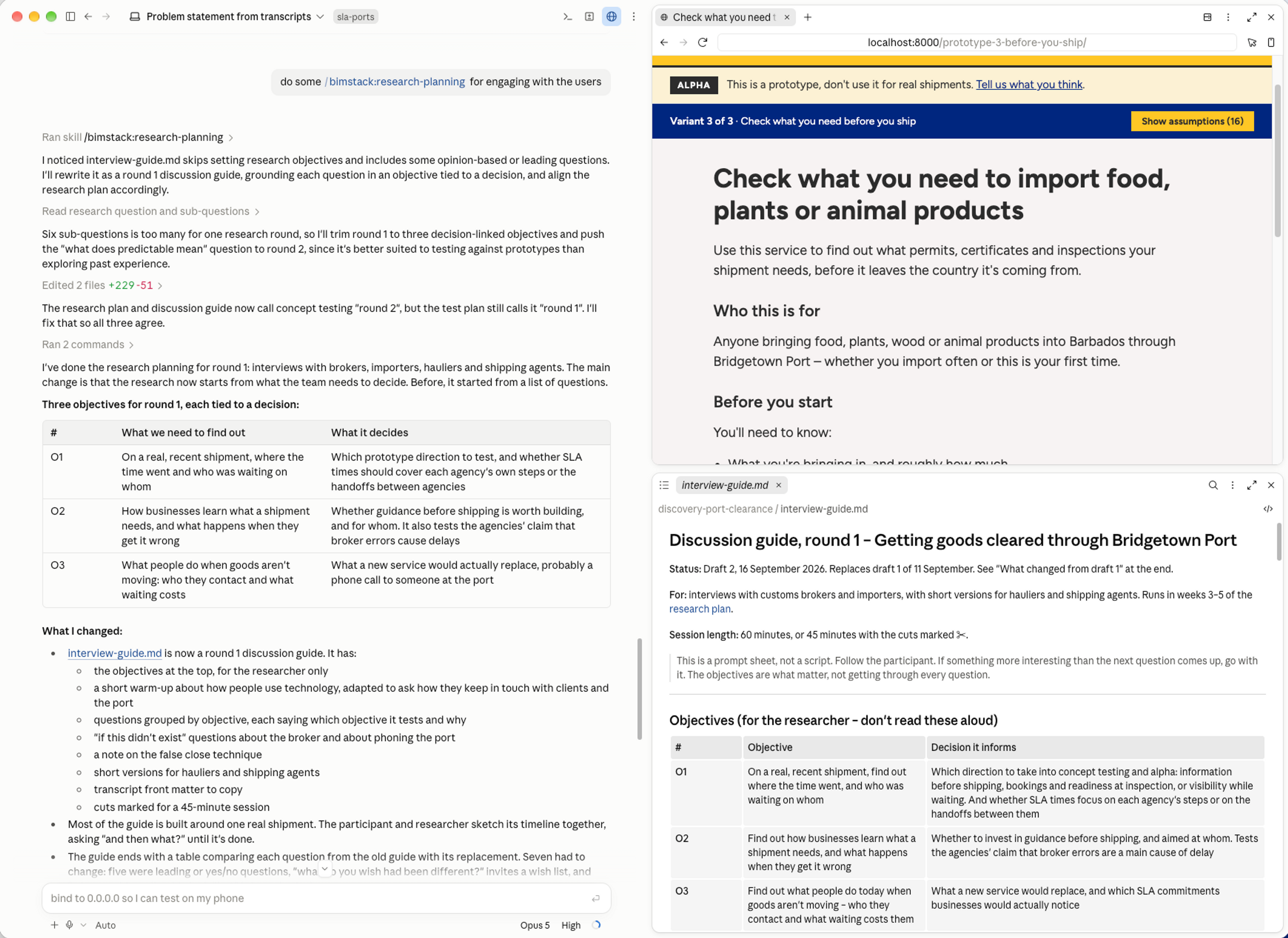
It turns a product brief into multiple testable HTML prototypes with testable assumptions surfaced inline, then feeds transcripts from user research back in to synthesise and produce the next iteration.
It also does what we call “synthetic research”, whereby it takes a look at a service and creates 5-6 personas of the likely users of that service, ensuring that edge cases - such as blind users, those with poor connectivity, low digital confidence, or low literacy - are also included. It then creates an agent for each of these users, has each agent attempt to use the service, and generates a report for the team outlining the challenges each user faced.
How Bimstack is changing the way GovTech teams work
1. Enabling AI-augmented teams
By teaching Claude expert UCD practice, it can do work that previously required expensive, hard-to-find specialists, while the local team directs it, judges it and learns from it.
We deliberately describe these as AI-augmented teams, not AI replacements. The people remain accountable for the service. What changes is that a small team's judgement now goes much further.
2. Helping smaller teams work faster - and learn faster
Bimstack fundamentally changes the arithmetic of delivery. Work that once needed a team of eight to ten people can now be done by two or three.
In the time a conventional team spends planning meetings and writing product requirement documents, an AI-augmented team can build ten prototypes, put them in front of users, and iterate on what it learns.
3. Unlocking the benefits of rapid prototyping
The ability to build rapid AI prototypes helps teams have constructive conversations quickly. The prototypes generated by the GovTech team with the help of Bimstack enable them to receive both clarity and immediate feedback from stakeholders on what they’re doing, and fast feedback from the users who interact with prototypes.
Training Bimstack
AI tools can only augment teams when the right foundations are in place. And Bimstack would have been impossible without the early work we did creating and publishing the Barbados Service Standards and their Design System.
We showed Claude these artefacts and asked it to use them as a constraint for the choices it makes. We also showed it blog posts by various prominent experts in Design, Research, Product Management, and posts by GDS and PD.
We found we could write structured instruction files - plain Markdown - that encode the principles a good digital team holds in its head: the design system, content standards, accessibility rules and patterns for how a government service should behave.
With those rules in place, the AI could start producing consistent, on-standard services.
For example: When I pointed Bimstack to the URL of a polyclinic check-in service and asked it to run synthetic research on it, Bimstack generated several helpful personas.
Prototypes are not production
It’s worth being clear that the first wave of AI-built services were prototypes, not production-grade services. Those who built the original workflow weren't professional developers, and making AI output production-grade requires a different layer: deterministic guardrails, proper engineering review, security and testing discipline.
To close that gap we brought in deeply technical practitioners from our Network - people who are embracing AI in new and interesting ways - to help the team combine rapid AI generation with production engineering rigour. This rigour - in the form of “Constraint Engineering” - is continuing to evolve as the GovTech team codify and clarify their approach to deterministic engineering.
The lesson is that AI collapses the cost of the first 80% - exploration, design, prototyping - which is precisely the part that used to consume large teams for months.
The final 20% still demands engineering craft.
We expect to see the teams of the future to be reshaped around that reality, not around the org charts of the pre-intelligence era.
Watch Abisola explain how synthetic colleagues can transform government teams.

Senior Director