
The Intelligence Era Organisation
Author Adam Maddison explores how senior leaders can get real results from AI investment, instead of treating it as a quick fix.
Read more
Back in 2016 I published the definition of digital that I’d been using for several years.
Digital: Applying the culture, processes, operating models & technologies of the internet era to respond to people’s raised expectations.
The digital revolution is still made of 1s and 0s, but plenty has happened in the decade since 2016. Eras are defined by what’s emergent; the big new thing that’s being folded into our lives. That was the internet. Today, it is the basket of technologies that comprise Artificial Intelligence, and what utility is unlocked by these new forms of intelligence, for the good or for ill of humanity.
Defining digital as being of the ‘internet era’ no longer feels quite right.
We’re still in the internet era; it's just become normality. It shapes our life, work, business and politics. In 2026, that is totally unremarkable. We don’t notice the internet any more. Like electricity, it just is.
And however we describe the era we're entering, we know that the future is never primarily defined by technology itself. What matters is how humans use technology to augment our emotional, relational and creative abilities to shape the world, as people always have.
Lots of things - APIs, open standards, digital public infrastructure, multidisciplinary teams, agility, user centricity - that were the right answer for the internet era are shaping up to still be the right answer in the next. Lots of things about the next era remain uncertain. Some AI companies will fail, some of the wilder claims made for the technology today will be wrong. Some will be right. We will look back and realise we were asking the wrong questions about how AI might change things, not just coming up with the wrong answers.
The original definition of digital was written as a rejection of technology being the sole driver of disruption. The idea that technology alone will save or doom us all is sticky, because it is beguilingly simple and makes a few people a lot of money. But it isn’t true.
The technology behind the internet wasn’t the reason the world changed, and the technology behind AI won’t be either. It is people - as individuals and in organisations - that drive progress through the ideas they have, the cultures they shape, the processes they follow, and the operating logic they build to deliver the outcomes they want.
The technology they pick is a crucial part of that mix, of course. But only a part. The conditions in which a technology is used, however sophisticated, are the difference between success and failure.
The other thing that hasn’t changed is why this matters: our raised expectations. We all now expect services, public or private, to do things we wouldn’t have dreamed of asking for 25, or even 10, years ago. We want it faster and cheaper too. Expectations will continue to grow. The internet era killed many businesses, and dealt a deep cut to state capacity in many countries. It also created incredible new companies, and great leaps in government competence. The next era will do the same. We will demand that it does. That future was, is and will be unevenly distributed.
What feels different today is the speed. The internet era played out over several decades. Governments and some companies got away with being pretty slow to notice and even slower to act. However, we didn’t all have networked supercomputers in our pockets in 2010. We do now. And so organisations that want to thrive in the next era need to have high situational awareness. They must be ready to adapt fast when - not if - our behaviours shift.
So an update to the definition of digital could be:
Applying the culture, processes, operating models & technologies of the AI era to respond to people’s raised expectations.
AI, because even if it is frothy, ill-defined and bears the same marketing burden as "e-this, e-that" used to, it is the term of the moment.
Applying the culture, processes, operating models & technologies of the agentic era to respond to people’s raised expectations.
Agentic, because it might be AI-powered agents being able to do things for us that will affect behaviours and expectations most - but that remains speculative rather than true today.
Applying the culture, processes, operating models & technologies of the intelligence era to respond to people’s raised expectations.
Intelligence, because the shift that matters is that access to deep and applied intelligence (not just knowledge) is being broadened to a far greater number of people.
All three have their merits and drawbacks. We can’t be certain, though the last is probably my favourite candidate - at least it was this morning. I'd welcome your thoughts.
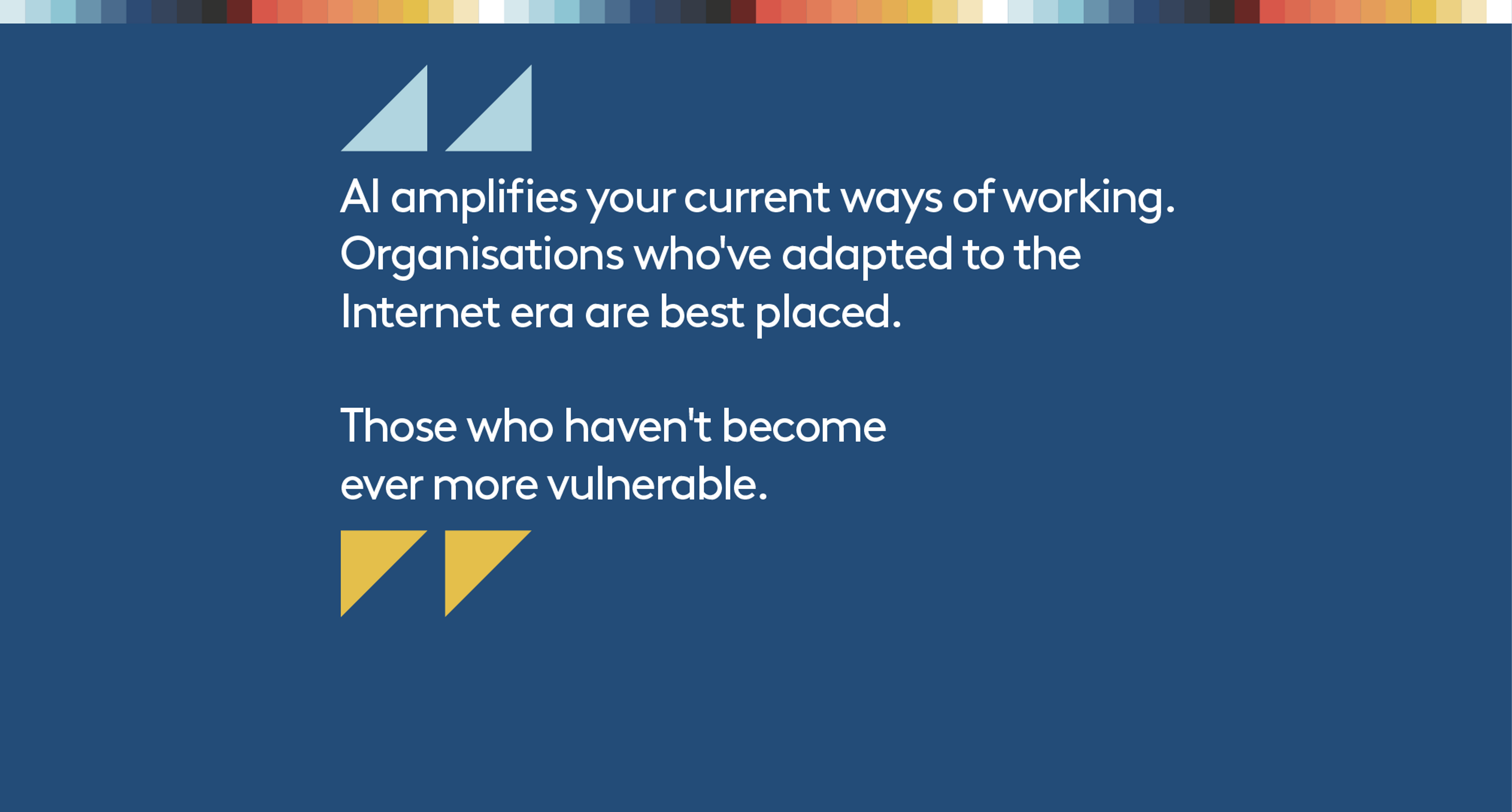
The organisations that adapt well to this next era will be those who have already worked hard to create the conditions for success. They will be optimistic, but prudent. They’ll continuously experiment, test new things, and learn from them. They’ll be mindful of sovereignty. They’ll be highly skilled at making computers talk to computers, and humans talk to humans. AI is an amplifier of an organisation’s current ways of working. Those who thrive in the internet era stand the best chance of thriving in the next. Those who are bad now become ever more vulnerable.
Today, it’s impossible to know exactly what this next era will be like. But it is perfectly possible for organisations to pick paths that make them better at responding to change, and to their user’s growing expectations, whatever form it takes. I’d start now.

Founder

