PD Newsletter #106: Digital sovereignty - the power to decide
April 2026
| 👋🏽👋🏻👋🏾 Hello, welcome. Our new book, Digital Sovereignty: The Power to Decide, is available for pre-order in advance of its autumn release. It explains how organisations can build the agency and capacity they will need to shape their digital future. Pre-orders are UK-only for now, but watch this space. Digital sovereignty, state capacity and AI are connected concepts we’ve been thinking about a lot recently. All 3 loom ever larger in everyone’s professional and personal lives. We don’t see that changing any time soon. This edition takes inspiration from those themes.
|
Latest from Public Digital
📅 We’re sponsors of TransformGov Talks. Join us for the next session on Wednesday 29 April at the MoJ in Westminster.
📢 We published a podcast exploring technology and change in organisations. Listen to the first two episodes on Spotify or Apple Podcasts, and watch episode 1 below.
🎧 Plus, listen to Andrew talk about state capacity and his essay on why the civil service needs fixing on YIMBY Pod, with James O’Malley, and the Policy Fix podcast, with Nesta.
Digital sovereignty💡PD was talking about digital sovereignty before it was cool - all the way back in 2023. The definition of digital sovereignty we blogged in 2025 recently featured in a House of Commons research briefing for parliamentarians on the subject. 🇺🇸 As well as being the subject of our upcoming book, digital sovereignty was the focus of PD’s session at Devex Impact House at the World Bank meetings in Washington DC last week. The discussion covered why digital sovereignty is about capacity not just control, and what a “post-aid” model of digital development might look like in practice. You can watch the recording here. |
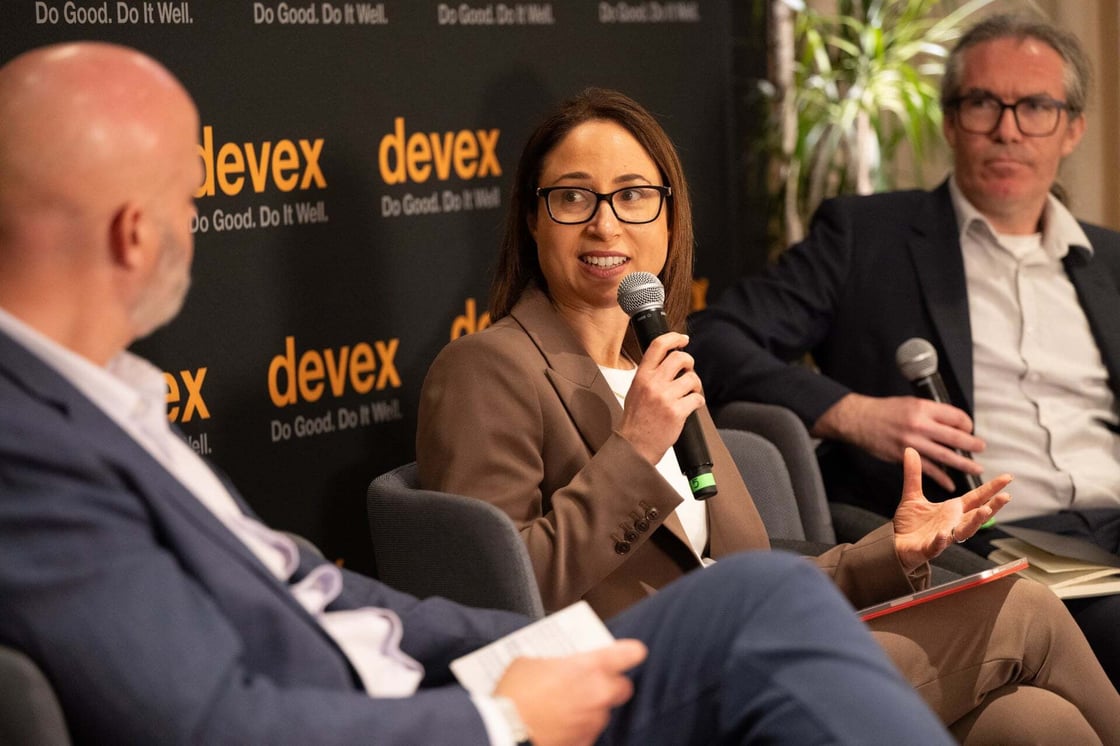 |
PD's Lauren Kahn and James Stewart at Devex Impact House: Capital Summit in Washington DC. Image credit: Kevin Allen & Devex |
🇫🇷 Meanwhile, the French government’s digital directorate has announced a migration of workstations from Windows to Linux, and has instructed government ministries to produce their own plans to eliminate digital dependencies by autumn 2026. 🔞 The European Union has just launched an open-source ‘anonymous’ age verification app. According to the European Commission the app doesn’t store your name, date of birth, ID number or any other personal information. 🤿 Digital sovereignty is not just a geopolitical and governmental issue. It materially impacts all kinds of organisations, including those in business and civil society. In this deep-dive post, Tom Watson writes about how ‘self-sovereign’ organisations might fundamentally change the process of applying for grants. 💸 Across all sectors, there can be a tendency to oversimplify digital sovereignty decisions into a binary ‘build vs. buy’ choice. In this paper written for the ODI, PD’s Lauren Kahn and James Stewart (with Cathal Long), explain how using that dichotomy for making software choices in Public Finance Management makes it difficult to meet the needs of today’s users, let alone tomorrow’s. |
AI🔦 “AI capability might be growing every day, but AI reliability is absolutely not.” Leisa Reichelt’s reading list spotlights useful thinking on AI in digital delivery, from its potential for testing prototypes from Simon Willison, to the flaws of LLM-generated personas from Constantine Papas. 🩺 Dr Benn Gooch writes about why he stopped using AI scribes in his GP appointments - and the longer-term effects of this technology on consultations. By using AI transcribing, “we are not merely saving time. We are externalising a cognitive function that was doing clinical work we didn’t realise it was doing.” Those who want to dig deeper into AI and health should listen to Joe Alderman from the University of Birmingham talking about how to develop AI that addresses health inequalities. 👔 John Cutler argues that organisations risk hollowing themselves out by using AI to replace their middle managers, mistakenly assuming that making tasks more legible (efficient and visible) is the same as maintaining legitimacy (the social trust and human judgment required to make work meaningful). 🛡️ Finally, a long read from the economist Arthur Charpentier on AI governance, audit and insurance: what it means that major insurers are reluctant to cover AI-related uses. |
State capacity📏 PD’s Anna Goulden explains how what you measure and how you measure it affects your organisation’s ability to deliver its goals, and offers 6 principles to help you use metrics effectively. “Many organisations claim to be data-driven, but unless they can choose and measure the right metrics, data can become meaningless, or can even detract efforts away from organisational goals.” 🌊 “What if governments are looking through the AI telescope from the wrong end?” Tom Loosemore predicts that citizens’ use of AI agents will lead to ‘agentic flooding’: removing the friction that defines users’ interactions with public services (and which actually works to protect those services from overwhelm). The city of Boston is already starting to prepare for that shift - using AI. 🏛️ What the death of Direct File under the Trump administration tells us about public interest capacity - great piece by Don Moynihan informed by his interviews with those who worked on Direct File. “The ability of government to competently help the public broadly reinforces liberal democratic systems.” 🍰 “You can’t eat dessert first.” Jen Pahlka writes about what DOGE could have been, and - more happily - how the Education Department of Louisiana bucked national trends to dramatically improve outcomes for pupils, roughly following the steps Jen and Andrew set out in their state capacity paper The How We Need Now. 🇨🇦 Alberta’s public servants are using AI to save 95% on the cost of rebuilding critical legacy government systems. Double points for the minister (Nate Glubish) penning the blog post himself - always a promising sign that state capacity building efforts are more than skin deep. 🙌 Test and learn approaches are showing up in more and more parts of the UK government. Education Minister Georgia Gould is interviewed about how she is looking to make it a core element in her efforts to reform SEND (Special Educational Needs and Disabilities). |
Something fun👨🚀 Mid-flight, an Artemis II astronaut reported back to NASA that two Microsoft Outlook instances were running on his computer and neither was working. We’ve all been there. |
Top posts from newsletter #1051️⃣ I built an AI service mapping tool, Sarah Drummond 2️⃣ A new communities of practice model for organisational maturity, Emily Webber 3️⃣ NS&I’s modernisation programme: A £3bn lesson in how to lose public trust, Ben Terrett |
👋 Join our networkPD proudly works with a network of freelance experts alongside our permanent consultancy team. We’re always looking for new network members. Apply here. |